

Say "kitchen cabinets" to most people and a shaker door is probably what they picture — it's been the go-to look for so long that it barely reads as a "style choice" anymore. In the last few years, though, a leaner version has been showing up more and more: the slim shaker. Same basic idea, trimmed down. If you're weighing the two against each other, the differences are smaller than they look in photos but they change how a kitchen feels in real life. Here's a breakdown of what sets them apart and which one tends to suit which kind of space.
What Are Shaker Cabinets?
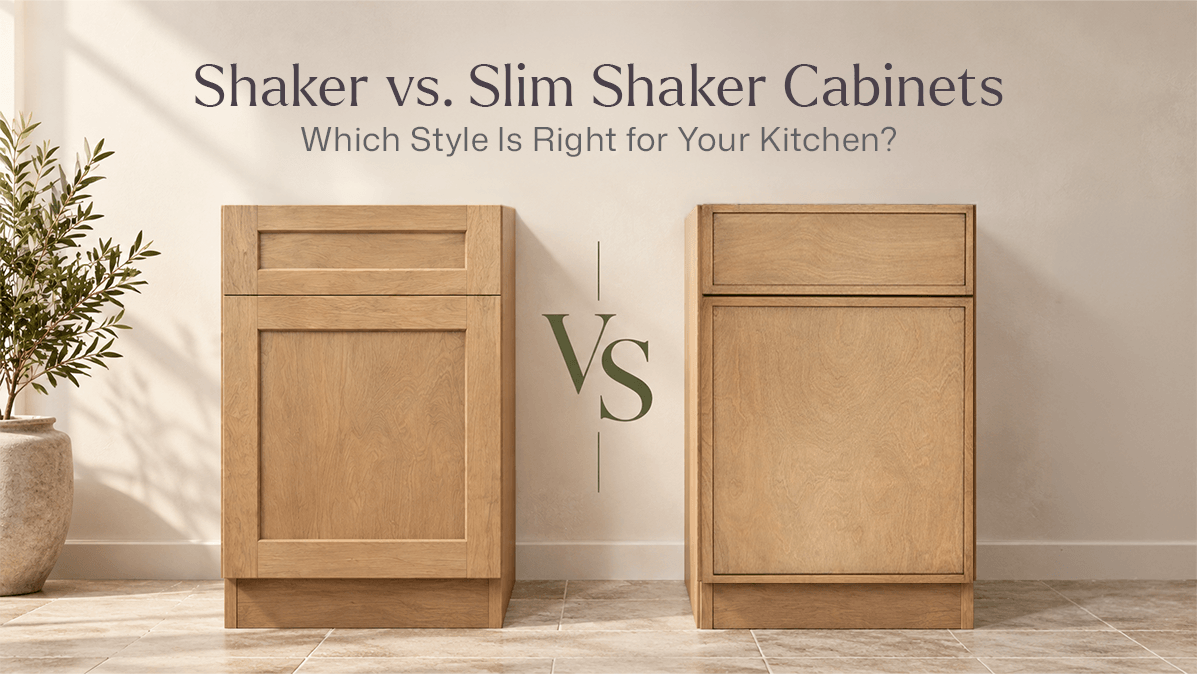
A shaker door is built from a frame around a flat center panel — a border on all four sides that sits proud of the panel itself, creating a visible line and a bit of shadow depth. The frame pieces (rails running horizontal, stiles running vertical) are wide enough to be a genuine design feature, not just a detail — typically somewhere in the 2 to 2.5-inch range. That proportion is where the "shaker" name comes from, tracing back to Shaker furniture makers who built around plain, functional joinery rather than ornamentation. It caught on in kitchens because it doesn't commit hard to any one era — it can lean farmhouse, transitional, or contemporary depending on the color and hardware around it. ProCraft's version of this is the Liberty Shaker line, which spans finishes from Liberty Shaker White Modern (LSWM) to Liberty Shaker Karmel (LSK).
What Are Slim Shaker Cabinets?
Slim shaker keeps that same frame-around-a-panel structure but cuts the rail and stile width down substantially — often close to half of what you'd see on a standard shaker door. The result isn't dramatic from across the room, but up close it changes the whole character of the door: instead of a bold border, you get a thin, quiet reveal line. It's still recognizably a framed door, just a much more restrained one. Think of it as shaker with the volume turned down. ProCraft carries this as its Slim Shaker collection, including finishes like Slim Shaker Oatmeal (SSO), Slim Shaker Rift-Oak Wash (SSRW), and Slim Shaker Karmel (SSK).
Shaker vs. Slim Shaker: Key Differences
Almost every difference between the two traces back to that one number — frame width. Wider frames on standard shaker mean more visible structure, deeper shadow lines, and a look that carries some weight, especially on larger doors or tall pantry cabinets. Narrower frames on slim shaker mean the door reads flatter and quieter, with far less going on visually even before you factor in color or hardware. Construction quality isn't the differentiator here — both are legitimate framed cabinet doors, built the same way structurally. What you're actually choosing between is how much frame you want to see.
Which Style Looks More Modern?
If contemporary is the goal, slim shaker is the more natural fit. Because the frame is so narrow, the door sits visually closer to a flat or slab-style front while still keeping a bit of dimension — enough to avoid looking completely flat, not enough to feel traditional. It tends to show up in kitchens that are going for a pared-back, uncluttered look, often with simple bar pulls or no visible hardware at all. Slim Shaker Oatmeal (SSO) and Slim Shaker Rift-Oak Wash (SSRW) are common picks here — warm enough not to feel cold or clinical, but restrained enough to stay firmly on the modern side of things.
Which Works Better for Traditional Kitchens?
Standard shaker still does more heavy lifting in traditional and transitional spaces. That wider frame has enough presence to hold its own next to crown molding, furniture-style feet, or detailed cup pulls — the kind of finishing touches that would get lost against a slimmer profile. Finishes like Liberty Shaker Ivory (LSI) or Liberty Shaker Karmel (LSK) lean into that classic register, pairing naturally with things like farmhouse sinks, warm wood floors, or patterned tile without feeling mismatched.
Popular Shaker & Slim Shaker Colors
Color changes how "modern" or "traditional" either door style reads, sometimes more than the frame width does. Within Liberty Shaker, Liberty Shaker White Modern (LSWM) stays close to the classic end of the spectrum, Liberty Shaker Blue (LSB) adds richer color while keeping the traditional frame intact, and Liberty Shaker Grey (LSG) offers a cooler, more neutral middle ground. On the Slim Shaker side, Slim Shaker Oatmeal (SSO) is the warm, do-anything neutral, while Slim Shaker Karmel (SSK) brings in a deeper wood-adjacent tone for kitchens that want some warmth without going full traditional. The same base color will generally look more current in the slim profile and a bit more established in the standard one.
How to Choose Between the Two
A handful of practical questions tend to settle it faster than staring at finish samples:
- What's already in the room? Ornate hardware, molding, or a farmhouse sink point toward standard shaker. A cleaner, more minimal kitchen points toward slim.
- How busy do you want the cabinetry to look? Wider frames add visual texture; narrower ones calm a space down, which can be useful in a smaller kitchen where every line matters.
- Do you want to combine both? It's fairly common now to run standard shaker on the main run of cabinets and slim shaker on an island (or vice versa) to add contrast without switching up the color palette.
- What hardware are you planning around it? Slim shaker generally pairs best with simple, low-profile pulls, while standard shaker has enough frame to support heavier or more decorative hardware if that's the direction you're headed.
There's no wrong answer here — it's really about matching the door to everything else already happening in the room.
ProCraft Shaker & Slim Shaker Options
Liberty Shaker and Slim Shaker both live under ProCraft's framed cabinet collection, with finish options that range from soft neutrals to deeper colors like blue and grey. The easiest way to get a feel for the difference is to look at both side by side rather than guessing from a small swatch — the full product collection shows every finish across both door styles so you can compare frame widths directly.
Frequently Asked Questions
Does a slim shaker cost more than standard shaker cabinets?
Not as a rule — price usually depends more on the specific finish and material than on frame width alone. It's worth confirming current pricing with your dealer since it can shift by collection.
Can shaker and slim shaker be used together in one kitchen?
Yes, and it's become a fairly popular way to add contrast. A common setup is standard shaker on the perimeter cabinets with slim shaker reserved for the island, keeping the color consistent while varying the profile.
Is one style harder to clean than the other?
Not meaningfully. Both hold up fine with normal cleaning — the narrower frame on slim shaker just has slightly less surface area for dust or grease to settle into.
Which style suits a small kitchen better?
Slim shaker tends to work well in tighter spaces since the narrower frame keeps the cabinetry from looking visually heavy, which can help a small kitchen feel a bit more open.